
Categories
Buying, SellingPublished November 3, 2026
Is the Virginia Housing Market Crashing? Here's What the October 2026 Data Actually Says

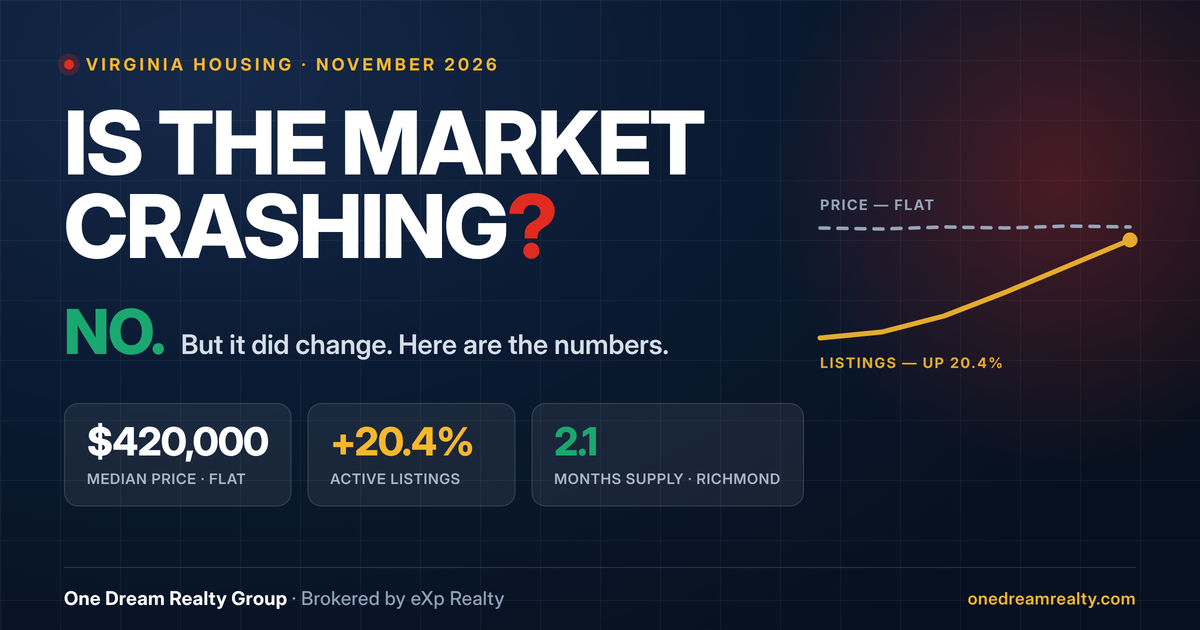
Short answer: No. Virginia's housing market is not crashing. It is slowing down — and those are two very different things. Statewide home sales fell 4.2% year over year in September 2026, the median sale price held flat at $420,000, and active listings jumped 20.4%. That is a market cooling under 7% mortgage rates, not a market collapsing. A crash requires forced sellers, falling prices and distressed inventory. Virginia has rising selection and flat prices — the opposite of 2008.
But "not crashing" is not the same as "nothing changed." If you are selling in Richmond, Chesterfield or anywhere in Central Virginia right now, you are competing with more homes than you were a year ago, and buyers are shopping with a payment that costs them roughly $200–$300 more per month than it did last fall. Here is the whole picture, number by number.
Watch: Is the Virginia Housing Market Crashing?
I break all of this down on video in about six minutes, including the one number almost nobody checks before deciding the market is falling apart. If you would rather hear it than read it, start there — then come back for the local detail below.
The Virginia housing market right now: the numbers
| Measure (Virginia statewide) | September 2026 | Change vs. a year ago |
|---|---|---|
| Closed home sales | 8,410 | Down 4.2% (373 fewer sales) |
| Median sale price | $420,000 | Unchanged |
| Active listings | 30,001 | Up 20.4% (5,074 more homes) |
| Sold dollar volume | About $4.4 billion | Down 5.2% |
| 30-year fixed mortgage rate | 7.24% (week of Oct. 29) | Up from 6.17% |
Sources: Virginia REALTORS® September 2026 Home Sales Report; Freddie Mac Primary Mortgage Market Survey, October 29, 2026.
Read that table again and notice what is missing: falling prices. Sales volume is down. Inventory is way up. Rates are brutal. And the median price still did not move. That is a market absorbing a shock, not breaking under one.
What a housing "crash" actually means
The word gets thrown around loosely, so let's define it. A housing crash is a rapid, broad decline in home values — typically 20% or more — driven by forced selling. Three things have to be true at once:
- Owners must sell. Job losses, payment shock or loan resets push people out of homes they cannot afford.
- They owe more than the home is worth. Negative equity means a sale cannot clear the debt, so the home goes to foreclosure or short sale.
- Distressed inventory floods the market. Banks dump discounted homes, which drags down every comparable sale around them.
That is the 2008 recipe. Virginia in 2026 has none of those three ingredients in meaningful supply. What it has is a buyer-affordability problem, which looks scary in headlines and behaves completely differently in the data.
The five numbers that tell you whether a market is crashing
1. Price direction
Virginia's statewide median sale price was $420,000 in September 2026 — the same as September 2025. Virginia REALTORS® noted that price trends varied widely by region, with some local markets up and some down. Flat is not a crash. Flat after a full percentage point of mortgage rate increase is actually a sign of underlying strength.
2. Inventory
This is the number that changed the most. Virginia ended September with 30,001 active listings, up 20.4% from a year earlier. Buyers have real choice for the first time since 2019. Sellers who priced for the 2022 market are the ones feeling the pain — and that pain is getting reported as a "crash."
3. Months of supply
Months of supply is the single best market-condition indicator, and it is the one almost nobody quotes. It answers: at the current pace of sales, how long until every listed home is gone? Under three months is a seller's market. Four to six months is balanced. Over six months, prices come under genuine pressure.
In the Richmond metro as of the September 2026 CVR MLS report: 2.1 months for single-family homes and 3.1 months for townhouses and condos. That is still a seller-leaning market for houses and a balanced one for attached homes. Nowhere close to crash territory.
4. Days on market
Richmond metro homes were still going under contract in roughly 27 to 29 days depending on price band. A crashing market does not move inventory in under a month.
5. Distress
Nationally, foreclosure filings rose 21% in the first half of 2026 compared with 2025 — a number designed to go viral. The context nobody adds: that works out to one in every 632 housing units, or 0.16%, and completed foreclosures were still 26% below the first half of 2020. Foreclosure activity is normalizing after pandemic-era protections expired, not spiking into a crisis. (Source: ATTOM Mid-Year 2026 U.S. Foreclosure Market Report.)
What's actually happening in Richmond and Chesterfield
I sell in Chesterfield, Richmond and the surrounding counties every week, so let me tell you what the statewide average hides.
- Richmond metro prices are still rising, barely. The CVR MLS rolling 12-month median sale price was $422,950, up 1.1%. Single-family homes specifically came in at a $440,000 median, up 1.9%.
- Pending sales slipped. Contract signings in the Richmond metro were down 4.7% from a year earlier in September. Fewer buyers are pulling the trigger at 7%.
- Inventory is up, but modestly. Richmond metro inventory rose about 5% — far less than the statewide 20.4% jump. Central Virginia did not get flooded the way Northern Virginia did.
- The split is by price point and condition. Updated homes under $450,000 in good school districts are still drawing multiple offers. Dated homes, odd floor plans and anything priced on 2022 comps are sitting 60+ days and cutting.
That last point is the real story of 2026. We do not have one market. We have two, running side by side, and which one your house lands in is decided almost entirely by pricing and presentation.
Why 2026 is not 2008
| 2006–2008 | 2026 | |
|---|---|---|
| Lending | No-doc loans, teaser-rate ARMs, subprime at scale | Documented income, full underwriting, mostly 30-year fixed |
| Owner equity | Widespread negative equity | Historically high equity cushions |
| Supply | Massive overbuilding into the downturn | A decade-long national housing shortage |
| Seller pressure | Forced sellers, foreclosure waves | Discretionary sellers who can simply wait |
| The constraint | Credit quality | Affordability — a rate problem, not a loan-quality problem |
The distinction matters because it tells you how this ends. A credit crisis ends in foreclosures and price collapse. An affordability squeeze ends when rates come down — and when they do, every buyer sitting on the sidelines comes back at once, into the same tight supply.
What would actually have to happen for Virginia to crash
I am not going to pretend nothing could go wrong. Here is my honest list of what a real Virginia downturn would require:
- Significant job losses in the region — federal workforce reductions, a major employer leaving, or a broad recession that puts owners in a position where they must sell.
- Mortgage rates staying above 7% for years, grinding down demand until sellers finally capitulate on price.
- Inventory climbing past six months of supply and staying there. Richmond is at 2.1 months for single-family. That would need to roughly triple.
Watch those three. If months of supply in your county crosses six and stays there, the conversation changes. Until then, the data says cooling, not crashing.
If you're selling in Virginia right now
You can absolutely still sell, and sell well. But the market is no longer doing the work for you. Three things decide your outcome:
- Price to the last 30 days, not the last 12 months. Comps from spring 2026 are already stale. Buyers with 7% money are ruthless about value.
- Win on condition and photos. With 20% more listings statewide, yours has to be the best-presented home in its price band, not the fifth-best.
- Budget for a concession. Rate buydowns are closing deals right now — often for less money than a price cut, and they hit the buyer's payment harder.
Want to know what your home would actually sell for in today's market? Text SELL MY HOME to 804-720-1286 and I'll send you a real pricing analysis for your street — not an automated estimate.
If you're buying in Virginia right now
This is the least competitive market buyers have had in six years. You have selection, you have inspection leverage, and you can negotiate again. The payment hurts — but you are buying at flat prices with room to negotiate, and you can refinance a rate. You cannot refinance a price you overpaid in a bidding war.
Thinking about buying? Text BUY to 804-720-1286 and I'll walk you through what your payment actually looks like at today's rates, including buydown options.
Frequently asked questions
Is the Virginia housing market crashing in 2026?
No. Virginia's statewide median sale price was $420,000 in September 2026, unchanged from a year earlier, while active listings rose 20.4% and closed sales fell 4.2%. The market is slowing because of mortgage rates near 7.24%, not collapsing from forced selling or negative equity.
Are home prices falling in Richmond, Virginia?
No. The Richmond metro rolling 12-month median sale price was $422,950, up 1.1% year over year, with single-family homes at a $440,000 median, up 1.9% (Central Virginia Regional MLS, September 2026). Individual neighborhoods and price bands vary.
Is now a buyer's market or a seller's market in Virginia?
It depends on where and what. The Richmond metro carried 2.1 months of supply for single-family homes and 3.1 months for townhouses and condos in September 2026. Under three months is still seller-leaning; three to six months is balanced. Statewide, with inventory up 20.4%, buyers have far more negotiating power than in 2021 or 2022.
What are mortgage rates in Virginia right now?
Freddie Mac's survey for the week ending October 29, 2026 put the 30-year fixed at 7.24% and the 15-year fixed at 6.60%. A year earlier, the 30-year averaged 6.17%. Your actual quote depends on credit, down payment and loan type — VA loans in particular often price better.
Should I wait for prices to drop before buying in Virginia?
That is a bet that prices fall faster than rates do. Virginia prices have been flat, not falling, and inventory remains below balanced levels in most of Central Virginia. If rates drop, sidelined buyers return to the same limited supply and competition returns. The better question is not "when will prices fall" but "what does the payment look like for me, and can I refinance it later."
How many months of inventory signals a housing crash?
There is no single trigger, but months of supply is the clearest early warning. Under three months is a seller's market, four to six is balanced, and sustained levels above six months put real downward pressure on prices. The Richmond metro is at 2.1 months for single-family homes.
Let's talk about your situation specifically
Statewide averages don't sell your house and they don't buy you one. What matters is your street, your price band and your timeline.
I'm Dustin Olverson, Branch Owner and Team Leader at eXp Realty – Richmond, and a 25-year U.S. Army veteran. My team closes about 30 homes a year in Chesterfield County alone, and we hold a 5-star rating across 46 Zillow reviews.
Book a 30-minute call: Grab a time here — Thursdays & Fridays, 9–11am.
Or text me directly: 804-720-1286. Text SELL MY HOME if you're selling, BUY if you're buying.
Data sources: Virginia REALTORS® September 2026 Home Sales Report (released October 22, 2026); Central Virginia Regional MLS / Richmond Association of REALTORS® Monthly Indicators, September 2026 (current as of October 10, 2026); Freddie Mac Primary Mortgage Market Survey, October 29, 2026; ATTOM Mid-Year 2026 U.S. Foreclosure Market Report. This article is general market commentary and not financial, investment or legal advice.
One Dream Realty Group · Brokered by eXp Realty · 717 N Courthouse Rd, Richmond VA 23836 · Licensed real estate agent in the Commonwealth of Virginia.

Dustin Olverson
| One Dream Realty | eXp Realty
or another way